Saturday, May 30, 2026
9 mins
An Ascension Reflection: Where Does the Eucharist Take Place?
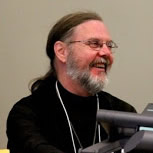
Those familiar with liturgical worship will be familiar with the pre-anaphoral dialogue— the dialogue between celebrant and people that takes place just before the celebrant prays the anaphora, the long prayer over the bread and wine which consecrates them to be the Body and Blood of the Lord soon to be received in Holy Communion. It is an important dialogue, indeed, even a crucial one, for it constitutes the celebrant’s blessing from the royal priesthood (i.e. the assembled laity) to offer the Eucharist in their name and as their mouthpiece. That is why he faces them throughout—or should face them, as Fr. Sergei Glagolev (inset above) taught us. Besides, who turns their back to someone in the middle of talking to them?
Wednesday, May 27, 2026
8 mins
Music Hath Charms
In his 1697 play The Mourning Bride, playwright William Congreve wrote that “Musick hath charms to sooth a savage breast [i.e. a savage heart], to soften rocks or bend a knotted oak”.
Wednesday, May 20, 2026
9 mins
An Embroidered Text?
Recently I watched the very interesting 2016 documentary entitled “Rome: Empire Without Limit with Mary Beard”. Ms. Beard, a very readable British scholar, functioned as host and narrator. Regarding Christ, Ms. Beard said, “one Jewish Rabbi had developed new ideas. His name was Jesus. The Sayings of Jesus, as they were called, were only written down later. But it’s clear enough that for the Jews he was preaching blasphemy. And at the beginning at least, for the Romans he was just another troublemaker. However exactly the story went, he was arrested, put to trial, and sentenced to death Roman-style, by crucifixion. The Romans must have thought “problem solved”, but it was only the start.
Friday, May 1, 2026
9 mins
The Authority of the Priest
In the Protestant Evangelical world the priest (sorry: “the pastor”) is not a figure of authority within the local church community but is primarily a preacher, an administrator. He can be available for counselling, if necessary. In large mega-churches he functions as a CEO. But he is not a figure of authority within the church; anyone can disagree with his sermon, his Biblical exegesis, and his doctrine in the same way as they would disagree with any Christian. The Evangelical version of the Reformation doctrine of “the priesthood of all believers” effectively functions to deprive the pastor of most of his traditional presbyteral authority.
Wednesday, April 22, 2026
10 mins
In Praise of Geegaws
In a wonderful old book by Leslie Farmer published in 1944 entitled We Saw the Holy City (mentioned briefly in last week’s blog), Farmer tells a story about how he led a group of soldiers on leave during the Second World War to the church in Bethlehem at Christmas time. The Reverend Farmer was assigned to Jerusalem as the Methodist Army Chaplain for two years during that war and through exploration and scholarly research he got to know many of the places of pilgrimage in Jerusalem and throughout the Holy Land very well. Besides his pastoral duties to the sick, he also spent much time talking to soldiers on leave passing through the city and would lead them to the holy places and explain their significance.