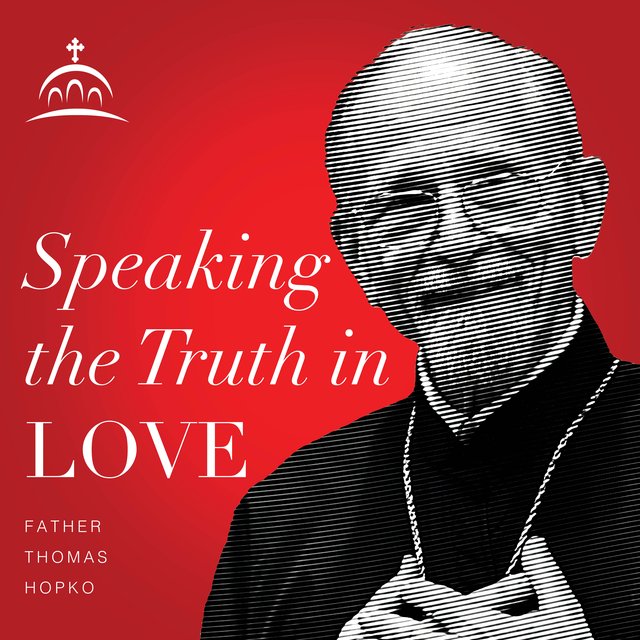
Providing compelling commentary on Christian belief and behavior, Fr. Tom Hopko has joined the growing podcast family of Ancient Faith Radio.
Fr. Tom reads all of his email and he will do his best to respond if requested as he is able.
Fr. Thomas Hopko is Dean Emeritus of St. Vladimir’s Orthodox Theological Seminary and the author of numerous books and articles including Christian Faith and Same Sex Attraction, published by Conciliar Press.
Visit our Schedules page to see when this podcast will be broadcast on Ancient Faith Talk.
This time, Fr. Thomas speaks of the Activities and Actions of God.
Fr. Tom continues his discussion, this time focusing on the Divine Attributes of God.
Fr. Thomas begins a four-part series on naming God and the language and words we use in the process.
Fr. Thomas explains the two ways the Holy Trinity are depicted in icons.
Fr. Thomas examines the Holy Trinity, which leads to the answer to Christ's question, "Who do you say I am?"
Fr. Thomas shows how, despite his persecution of the early Church, St. Paul was indeed an Apostle-- by having seen the risen Lord and through his suffering.
Fr. Thomas discusses "the rock" upon whom Christ built His Church and St. Peter's role in that early Church.
With the Apostles' fast at hand, Fr. Thomas reflects on the practice and rules for fasting.
Fr. Thomas shows how we are all called to be Saints and examines the many different kinds of Saints.
The day after Pentecost is the Feast of the Holy Spirit in the Orthodox Church and Fr. Thomas uses it to examine more closely the "Spirit who proceeds from the Father."
Fr. Thomas looks at the roots of Pentecost-- the coming of the Spirit-- in Old Testament worship.
Fr. Thomas takes a closer look at the seventh Sunday of Pascha-- the Sunday between Ascension and Pentecost.
Fr. Thomas rejoices in the enthronement of the crucified One, raised and glorified.
What does this miracle of Christ tell us about the blind man, about God, about Jesus and ultimately, about us?
Fr. Thomas outlines a hypothetical commencement address he would give to graduates of all faiths and beliefs, then blesses us with his actual address last year to the graduates of St. Vladimir's.
Fr. Thomas looks at the Gospel for the fifth Sunday of Pascha-- a miraculous sign that at first glance doesn't seem to involve a miracle.
Comparing the two sources for readings during the Paschal season-- the Acts of the Apostles and the Gospel of John.
Fr. Thomas enumerates the seven great messianic signs of Jesus in St. John's Gospel, focusing on the healing of the paralytic at Bethesda.
Fr. Thomas examines who the Myrrhbearing Women were and clears up some misconceptions about Mary Magdalene in the process.
Fr. Thomas uses the Paschal icon as an opportunity to clear up some misconceptions about Sheol/Hades and Gahenna/Hell.
Father Thomas educates us on why the Sunday a week after our Lord's Resurrection is also called Antipascha.
On this, the greatest of all Feast Days, Fr. Thomas explains what we, as Orthodox Christians, know for certain about Jesus Christ.
Fr. Thomas examines the Mystery of the Crucifixion and Resurrection of our Lord and how it led to the re-creation of the world.
Fr. Thomas continues his examination of Passion Week with Jesus' teachings on the final judgement.
The week before Pascha begins with the Bridegroom Matins. Christ is the Bridegroom and we are the Bride, joined in perfect unity through His crucifixion.
Fr. Thomas takes a closer look at the "Celebration of the Kingship of Christ".
Fr. Thomas explores the ultimate Messianic sign from the Gospel of St. John.
In this last week of Great Lent, Father Thomas connects the parable of the rich man and Lazarus with Christ's raising from the dead of the actual Lazarus.
24:47
Fr. Thomas contrasts the story of the fallen, then raised Mary of Alexandria with that of another Mary-- the Theotokos.
17:16
Fr. Thomas gives an overview of the services for the 5th week of Great Lent and their final emphasis on penitance and repentance.
18:38
Fr. Thomas starts with a review of the Gospel reading of Mark for the Fourth Sunday of Lent and transitions to the 5th Sunday explaining how reigning with our Lord is dependent on suffering with Him.
23:01
On April 7, we remember the repose of St. Tikhon, Patriarch of Moscow and Apostle to America. Fr. Tom has 3 stories to tell about this venerable Saint.
It is at this point in our Lenten journey that the Church contemplates the instruction of St. John Climacus and his Ladder of Divine Ascent. Fr. Tom takes us step by step through this treasure and makes it practical for us non-monastics!
(33:36)
On the 3rd Sunday of Great Lent, we concentrate on the Cross of Christ and Fr. Tom helps us understand what it means to take up our cross.
Fr. Thomas explains the significance of St. Paul's letter to the Hebrews in our Lenten journey.
22:56
Fr. Thomas examines the Prayer of St. Ephraim and why it is so appropriate for us during Great Lent.
22:20
As we continue to remember the significance of the Annunciation, Fr. Tom gives a helpful reflection on the Magnificat.
On March 25, exactly 9 months before Nativity, the Church celebrates the Annunciation to the Theotokos that she will be the Mother of God. God's declaration through the angel Gabriel, however, had a contingency attached. Listen to find out what it was.
Looking for an inspiring book to read during Lent? Try the Bible! Fr. Tom specifically recommends certain books of the Bible during this season.
10:00
Fr. Tom offers thoughts on the healing of the paralytic.
(23:50)
On the 2nd Sunday of Great Lent we remember St. Gregory Palamas and Fr. Tom instructs us on why he is so important in our theology about knowing the unknowable God.
34:00
Fr. Tom gives a meditation on the rich meaning of the pre-sanctified liturgy of Great Lent.
16:37
You won't find a more concise and helpful explanation of why Orthodox Christians keep and venerate icons.
29:21
Great Lent is considered the tithe of the year, during which believers try to be what they ought always to be. Fr. Tom, in response to a request once made of him, shares with us a list of "things that a believer would do if he were really a believer."
Fr. Tom considers the act of asking for forgiveness, as well as who it is we hurt when we sin.