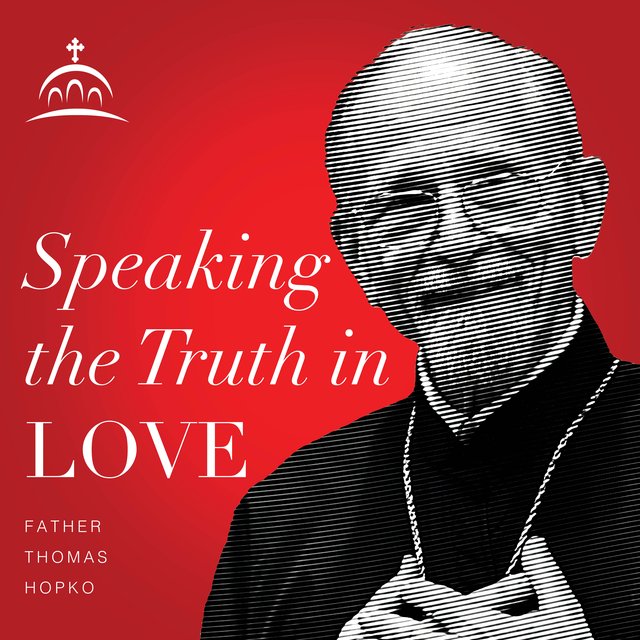
Ancient Faith Radio presents Speaking the Truth in Love with Fr. Thomas Hopko.
Fr. Thomas is the Dean Emeritus of St. Vladimir's Orthodox Seminary and the author of numerous books and articles.
From his study in Elwood City, Pennsylvania, here is Fr. Tom.
I'm continually asked about reading materials, about books—books which have come out recently, old books, sometimes disputed books, just to make my opinion known and to comment upon them and even to encourage the reading of certain books.
And I've been doing that on Speaking the Truth in Love on these podcasts just from the beginning. And I would like to do that today.
I'd like to take a few minutes to introduce you to an author and a book that I think you can read and it will help you very much. That is my conviction.
This book is by a woman named Dee Margaret Pennock, P-E-N-N-O-C-K.
Dee Pennock is an elderly woman. Many years ago in her youth, she converted to the Orthodox Church.
She was a seeker, she was an editor, she worked for Harvard University Press and other places.
And at one point, she came into contact with a very famous theologian, Orthodox theologian, who worked in America at St. Vladimir's Seminary, at Holy Cross, at Harvard, at Princeton.
His name was Fr. George Florovsky.
And I can't remember exactly how it happened. She met him in some way, and she contacted him and asked him about things. And he discussed with her a little bit.
And apparently what he told her was that since she's reading the Scriptures and familiar with them and seeking and so on, that if she were interested in Orthodoxy, what he would suggest her to do—I love it what his suggestion was—he said, why don't you read for a couple of years?
Sounds like something out of the Desert Fathers, you know. In the old Desert Fathers, a young man would ask an old man for a word. He'd give him two sentences and then tell him: Go work on it for a year and then come back and we'll talk, you know. That's the way things were done in the old days.
Well, even in the not so old days, I don't know how many years ago, maybe a half century ago or so, 50 years maybe—in any case, Fr. Florovsky said to this young woman: Take a couple of years and read through the early Church Fathers.
He suggested the Nicene, Ante-Nicene Fathers series. Just read through it. See what's there. Try to understand it and see how these holy men are understanding the Christian faith and how they are interpreting the Bible, how they're interpreting the holy Scriptures.
And she did this, and she ended up joining the Orthodox Church.
Now, in the 1970s—I think it was the 70s—this woman wrote a book that we used to use in those days. It's quite a long time ago. It was called Who? Who am I? Who are you? Who is God? The title was Who? with a question mark. And then it was Who is God? Who am I? Who are you?
And it was a very good book. I remember we used it for educational purposes in those days, high school students. We recommended it.
And it was basically a reflection on the human person and human being and divine being and the relation between the two as shown, as explicated, so to speak, and explained by the ancient Fathers of the Church. And not only so ancient, but the Fathers of the Church, the saints through history.
So this woman became a lover of patristic literature, a reader of patristic literature.
And in addition to the Church Fathers who wrote about theology and doctrine and liturgy, she became interested in the Fathers who write about ascetical and spiritual life, about the human mind, the human soul, the human will, the passions, the emotions.
And of course, in searching, into this literature, she came upon the Philokalia.
And she found in those, in the old days, so to speak, in the days of our youth, that there were two volumes published by Kadloubovsky and Palmer in England.
One was called The Early Fathers on the Prayer of the Heart, and another was called The Early Fathers from the Philokalia. I think that's simply what it was called.
One on the Prayer of the Heart, one on the early Fathers. In any case, there were two volumes.
They were done by these two translators, Kadloubovsky and Palmer. And they were published.
And many of us in our young days, we read those books. Now, of course, in more recent time, there are four volumes in English, done in England again, under the leadership of Kallistos Ware, Metropolitan Kallistos, with other translators that worked together with him.
Philip Sherrard, I believe, was one. Right offhand, I can't remember the other, and I'm not at home right now so I can't check it out, I don't have the books with me,
but in any case, we have those translations very carefully, very scholastically done, in four volumes of the Philokalia Fathers.
Now, of course, it is the teaching of the Orthodox Fathers themselves and the Church tradition that one should not get into this literature until one is definitely committed to Christ the Lord, definitely at least somehow knowledgeable of the Holy Scriptures, especially the New Testament, unless one is a practitioner of the Church and the sacramental life and identifying with the doctrine of the Church.
And also, one needs to be under direction in some way, to have a pastor or an elder or a spiritual father, someone to guide one in these writings.
In fact, St. Ignatius Brianchaninov in the 19th century, he even recommends that a person, and even a monastic person, would not read these writings until they had really come to know the New Testament very well, and the Bible generally very well, and had some spiritual experience of trying to live according to the commandments of the Gospel, as he puts it, before one gets in any deeper, so to speak,
because one of the terrible things that happen to people is they get in over their head, and someone says they bite off more than they can chew, and then that destroys them.
In fact, there are a couple of Church Fathers—Gregory the Theologian, for example, and Ephraim of
Syria—who actually say that was the original sin of Adam, that maybe God would have let Adam and Eve, humanity, participate in that tree of life, and not only the tree of life, but the tree of the knowledge of good and evil, but they had to grow up to it.
They had to learn how to live first, and then they could go in deeper.
That's not a common understanding of the primordial sin of humanity, but it does say that there were those who thought it was pride, you know, trying to be higher than you are, getting involved, as the psalm would say, with things too wonderful and marvelous for me.
There is an order in spiritual life. There's an order in theology.
We begin with milk, and then we go on to meat, and that's how it is.
And if we take meat when we're still on milk, as the Apostle Paul says, we can choke to death, you know? And we become crazy, even.
And St. Ignatius Brianchaninov even says that, that people who read this deep and high mystical ascetical literature, without being grounded in the faith, without being knowledgeable of holy Scripture, without having lived a certain type of life of discipline, without being under direction, they can really get into big trouble.
And I'm afraid that this is one of the things that's happening today on this planet Earth.
Everybody everywhere is reading this great, high-level Scripture, high literature, and quoting Church Fathers, and—
I'm amazed. I have to honestly say on the radio:
I'm amazed how there are people who send me emails, and they're telling me this and telling
me that, and calling me a heretic or whatever.
And I just have to smile sometimes, because the person who does it, they've only been in the Church like two, three years, and man, I'm 72 years old, and I've been studying this since I'm 18!
It doesn't mean that I'm always right.
In fact, I'm sure I'm not. I'm absolutely sure that I'm not.
But it's amazing how people can, you know, just quickly correct people because they know so fast and so easily.
And there's a kind of presumption there that is not healthy.
We need more humility, more sobriety, it seems to me.
But in any case, this woman, Dee Margaret Pennock, it seems to me that she's paid her dues, you know what I mean?
She's shed blood. She's lived through this. She's not a young woman anymore.
But she has been struggling with these things her entire life.
That's pretty apparent when you read this little book that I'm going to talk about right now.
After writing that book, Who?, in the 1970s—
And it probably is still available. I would even recommend it.
If you have an opportunity, you know, Google, you know, go on and check out Dee Pennock, P-E-N-N-O-C-K.
And you will find out about her, and you will find about this book, Who?
Now, she wrote another book in 2006, not so long ago—five years ago—that was called The Adam Complex, and it's not a very long book.
And I read that book, and I spoke with Dee about it.
I emailed, and I had a chance to get mail with her, because I had a little difficulty with a certain part of that book, and so on, and it's very interesting that she said that she wants to rewrite that book.
And she hopes that it, you know, that it was published in 2006, but she herself right now says that, she said, if I talk on the radio about her—
because I asked her, blessing, you know, I told her I wanted to do it—
she said to me, perhaps that book, The Adam Complex, is not one to be strongly recommended right now, because she herself was not completely and totally satisfied with it, and maybe she'll rework
it if she still has the energy and strength, and maybe not.
I still thought it was a good book, frankly.
I still thought it was a good book, The Adam Complex, where she deals with the effect of apostasy, and the effect of loss of obedience to God, and so on, and what that does to human beings, and what it does even to us as men and women.
But this book, that we're going to talk about now for a little bit, I think is a really good book.
The title of the book is Path to Sanity.
The subtitle is Lessons from Ancient Holy Counselors on How to Have a Sound Mind.
This book is published by Light & Life Publishing Company in Minneapolis, familiar probably
to most of you, I hope, anyway, Light & Life Publishing Company, a wonderful publishing
company that produces many good books.
They publish books about Christianity and the Orthodox faith, and usually books on a more popular level, not so much a scholarly or academic level, but easily accessible to the committed Christian person who is not necessarily formally theologically educated.
So Light & Life published this book in 2010. That means last year.
So it's a new book, and it's called Path to Sanity.
Now, I did have a chance to be in Congress.
I was in contact with Dee Pennock about this book, and she thinks that if it's published again, when it might be actually, it may even be published with some illustrations.
That would be very interesting. I kind of hope that would happen.
But she said maybe—some of her friends were telling her and her critics and commentators said:
you know, maybe a better title of this book would be God's Path to Sanity, Lessons from Ancient Holy Counselors on How to Have a Sound Mind.
Because the ancient holy counselors that she is appealing to in this book are the Church Fathers, are the Church Fathers that she has read and studied her entire life.
And the title might be better, God's Path to Sanity, because what the Holy Fathers and the saints are teaching is,
if we go to God Almighty, the God who is revealed on the planet Earth in Jesus Christ, Jesus of Nazareth, the Messiah, the Lord, the Savior, the Incarnate Logos, wisdom, word, power of God,
these men—and they're mostly men, there's one or two women quoted—but mostly men—who try to tell us how God would have us deal with our insanity,
how God would have us deal with our unsound mind, how God would have us deal with our rambling thoughts and invasive feelings and emotional drives and passionate, you know, enslavements and
all this kind of stuff.
It's actually, you might say, it's ancient holy counselors, but these lessons from the ancient holy counselors, they claim, come from God himself.
They're revealed to us by God himself through the holy people of the holy Scriptures, the Old Testament, and, of course, the apostles of the New Testament, the writers of the Scriptures,
and the earliest writers about Christian spiritual life in the Church, in the Christian tradition, and those whom we consider to be those who taught the truth
and who rebuked those who were wrong and in error, and, of course, those who kept orthodoxy within the Church against Church members who are trying to, you know, change the faith and call it orthodox. Those people are called heretics.
A heretic has to be a member of the Orthodox Church who's claiming what they teach is orthodox.
"Heretic," by the way, isn't a word that simply means anybody who's mistaken.
I may talk about words on the radio here pretty soon, actually, because I think sometimes we're very sloppy with our use of words, even people who should know better.
But in any case, she's read these things her whole life, and my opinion is that she has digested this material magnificently.
In other words, I have the impression when I read this book that this woman knows what she's talking about.
You know how it says in Scripture that Jesus taught as one having authority, not like the scribes?
Well, I wouldn't dare to say a little bit about that in regard to this woman.
She does speak as one having authority. By that, it means she's not a scribe, simply.
It's not like she read three or four Fathers, put some quotes together, went searching for some quotation to support what she already believes.
You know, we all do that. You know, when we think something and we're convinced of it, we go look to find the holy Father who will support what we think.
And sometimes we'll find one or two and forget that 98% of the others don't agree with them, you know?
And that's very important, by the way. Every single Father is not infallible. Every single Father and saint has some mistakes in what they teach.
And what we hold to is the consensus of the Fathers, the consensus patrum, you know, what they hold in common, what they defend in common.
And it's hard even sometimes to always determine what that is.
St. Photios the Great, for example, he said some of the earlier writers taught things that actually came out to be judged as being wrong, but they only said them in passing; they were never challenged; they never had a chance to think it through, so you can't really convict them of being heretical or something like that.
They were just mistaken or one-sided or whatever and didn't have the opportunity to work through the issue.
St. Photius said this when there were those who claimed that some of the early Church Fathers were actually teaching a doctrine of the Trinity that somehow was teaching the filioque, you know, that the Holy Spirit proceeded from the Father and from the Son.
But it was, how can you say—it wasn't in a time where that was really looked at directly and all the implications, and then when there really were fallacious interpretations of it that needed to be rebuked and corrected.
So, you know, I would like to just appeal again. And every time I have a chance to do this, I'm going to do it, even if some of you don't like it.
I quote my teacher, Professor Serge Verhovskoy, who was—
You know, some people don't like professors. As someone wrote to me recently: I'd rather listen to the holy Fathers and the saints rather than you profs.
Well, I never felt comfortable being a prof. I always felt miscast.
But my prof, my professor, Serge Verhovskoy, he was a layperson, a humble man, never became a priest, spent his whole life studying theology, was a totally moral man, a man who was really sacrificial, gave his whole life to the Church,
and to demean him, a teacher of theology, and not a monk somewhere—he had a wife and three daughters—that's not fair. That's really just not nice, and it's not true.
And we should really be more careful with that, and with our language also.
But in any case, Professor always used to say that if you study each of the Church Fathers very, very carefully, you'll almost always find one thing or another that really did not become part of the great Tradition:
something that was either erroneous or too one-sided so it could be easily misunderstood, or whatever.
And then he said that famous line that I've quoted before: The holy Fathers are not Holy Spirits, you know, they're not infallible. Only God is infallible.
But when you read them all together and put it all together, then you have a vision where you see the consensus.
And then if you're trying to live in addition to reading what they say, but you're trying to do what they taught, then you will come up to see for yourself what it is that they were teaching and how it works, and then you will see how it all hangs together, so to speak.
Now this is why I'm recommending this book, because I believe that Dee Margaret Pennock has done this. I really do.
I really think that she has digested the material, so to speak.
She obviously has tried to live it. She obviously has gone through the temptations and the trials and the difficulties that anyone will necessarily have,
even the doubts that everyone will necessarily have when they try to be a Christian, when they try to follow Jesus Christ, God the Father, by the Holy Spirit, attacked by the demons—you know, the world, the flesh, the devil—
And especially at this late time in human history, you know, the 21st century, only God knows what's not going on out there!
She's been through a lot, and like I say, she's an elderly woman, so she's been around the block a few times. She's been through things. And that comes out in this book.
And how does it come out?
It comes out in how simply and clearly she puts together the teaching
and it's shown by how she selects the quotations that she quotes to make the point that she is trying to make.
And she's trying to make that point not because she thinks it's cool or great, but because it's such a common point in the Tradition that she knows which ones to quote who have said it as clearly and sharply and convincingly perhaps better than others in the Tradition.
In other words, she's so familiar with the material and with the life that it seems like she just speaks about it easily.
And when you have a book, even a small book like this one, a popular level book—it's, you know, 213 pages long, but rather big print and a lot of white space in it.
When you have a book like this, what is loaded with quotations—
And what is nice is that in the back of the book, they identify these great counselors that she quotes, these Fathers that she quotes.
And there are [in] this listing. They tell about each one of them a little bit. It's very handy, very helpful for people who are not too familiar with it.
But that is, you know, 12 pages long, of the names of those who are quoted in the book.
But the way she organizes the quotations, the way she has selected them, the way she has put it all together, how her own, so to speak, digestion of this material, how she puts it in her own words—
in other words, what she herself is writing and how she weaves into it these quotations from the tradition of these ancient Christian Church writers—
mostly ancient; some are more contemporary, you know, they're not just the first century; there's some who are, you know, more closer to our time.
But I think it's just magnificent.
And on the back of this book, there are endorsements of the book, people who endorse the book.
Frederica Mathewes-Green, with whom you are, I'm sure, all familiar, she says,
"Path to Sanity presents the classic Orthodox path to mental and emotional healing in Christ.
Nowhere else, to my knowledge, has this cure been set forth for contemporary readers, so clearly and succinctly."
And I would definitely agree with that.
Fr. Theodore Stylianopoulos, a New Testament scholar who taught all his life at Holy Cross Greek Orthodox school in Brookline, said,
"This book contains a treasure of insights from Scripture and Tradition, a welcome guide to mental, emotional, and spiritual soundness."
Now, a certain Archbishop Chrysostomos, who's a psychologist with a doctorate from Princeton—he's an Orthodox archbishop, a theology professor, and author, this is what he says.
Archbishop Chrysostomos says, "Dee Pennock's newest book, Path to Sanity, speaks of the therapeutic aspects of Orthodoxy with clarity, an elegant simplicity, and an amazing charm. It is a brilliant summary of the patristic method of overcoming the ancestral sin and attaining sanity"—one could even say sanctity—"sanity in the love of Christ."
That is so well put, I want to read it to you again.
"Dee Pennock's newest book, Path to Sanity, speaks of the therapeutic aspects of Orthodoxy with clarity, an elegant simplicity, and an amazing charm. It is a brilliant summary of the patristic method of dealing with and overcoming the ancestral sin and attaining sanity in the love of Christ."
I agree with that totally.
Now, the book—it's a simple book, in some sense—it's not difficult to understand, except if we are ourselves deeply embedded and enslaved in passions, then we might have some problems with it.
But it's not difficult intellectually to understand. It's written in everyday language, in very clear prose, as Archbishop Chrysostomos says, "elegantly and with charm." It's really something.
And this is— I'll just let you know what the contents of the book are.
The introduction is called "Guides Along the Path."
And in that first introduction, she just introduces those whom she is going to be quoting.
And then she even quotes them, you know, about what the path is and how it works.
And right from the beginning there, just even in that introduction, which is only, you know, six pages, seven pages long, she quotes Jeremiah the prophet, she quotes Christ in the gospels, she quotes St. John Cassian, she quotes Kallistos and Ignatius, she quotes Gregory of Sinai.
You know, and she introduces who these Fathers of the Church are and why it is that we would
get to know them and to follow them.
And she begins even by saying that the human being is tending toward God, like St. Augustine said,
and that we are looking for light, we're looking for health—if we are not completely jaded and completely sold to corruption and under the complete and total power of the devil.
Even then, human beings are thinking that they're trying to find something that is good and true, even though they're totally misguided.
But in any case, it's pretty much of a case that human beings are made toward God, that they're made for fulfillment in God.
They're made for health. They're made for sanity.
We're not created to be sick and crazy. We're not.
We're not created to be thrown around by every wind of doctrine, as St. Paul says, and every passion and elemental power of the universe.
We're not meant for that. That's not what we are as human beings.
But we brought that all on ourselves. That's the point of the ancestral sin.
People sin, and they infect and poison each other with sins, and we're all caught up in this together.
Then she says how God acts to heal us, save us, bring us to sanity, and how these holy Fathers are those who did it, who believed in him, who suffered it, and so on, and then they have something to teach us.
Then she begins, actually, after this introduction, with what it is that she herself wants to say about these things,
about how to have a sound mind, how God, through his saints, would teach us how to have a sound mind.
And of course, here she definitely—it's said implicitly and explicitly in the whole book—that if we're just going to psychiatrists and psychology and counseling, it can be helpful, but it's extremely—it could be very harmful, too—but it's very limited,
because we are made in the image and likeness of God for divine life,
and until we find God and the truth of God, we're just muddling around, you know, maybe a little bit better, maybe a little bit worse, God doing the best he can with us,
but we have to have a kind of conscious intention to follow God and find God and believe in God, and that's the way that we come to healing.
Now, the first chapter of the book is called "The Soul You've Got to Work With,"
and here she speaks about the aspects of the soul, the governing faculty, the thinking faculty, the zeal faculty, the desiring faculty, free will.
She puts that together magnificently.
She quotes Justin Martyr, she quotes John of Damascus, she quotes Irenaeus, she quotes Symeon the New Theologian, she quotes Lactantius, she quotes John Chrysostom—
and I'm just, like, leafing through the book here.
She quotes Clement of Alexandria—but the way she puts it together is just marvelous.
And then, of course, she's quoting the Scripture all the time, and she's quoting the Fathers quoting the Scripture.
Now, of course, it is simply true that the Church Fathers, in their structures of looking at human beings, very often follow the Platonistic line.
I mean, this idea that the human being has a governing faculty but is driven by zeal, and when that gets deranged, it becomes rage and anger, and we're driven by desires which are good and holy, desiring truth and goodness, but that gets derailed, and we ended up desiring what we think is good and true, but it's not; it's totally destructive.
So our desiring faculty, the epithymia, becomes just lust, you know, and we're lusting after all kinds of stuff that we think's going to fulfill us.
So she deals with that in the first chapter.
Then she goes on to spiritual defects the soul is born with, and in The Adam Complex book, she did deal with that, too, namely that we are born with predispositions to certain sins.
We inherit our nature, our particular humanity, from our fathers and their fathers.
There's ancestral sin through the generations, and this affects us.
And, you know, she refers to Sigmund Freud and says, you know, this guy didn't see nothing, but the Church Father saw way more and better what he saw and how to understand that and how to, in fact, correct all of those things.
So what she says in this second chapter is that basically there are three basic passions of the soul, of the mind, the heart, the will: pride, vainglory, and self-love.
And even those are the three things that the devil tempted Jesus with in the gospels of Matthew, Mark, and Luke when he took him into the desert after he was baptized and begins his public ministry.
And this pride, vainglory, and self-love—which sometimes is called in our trade the "unholy trinity": pride, vanity, and self-love.
And by self-love, she doesn't mean loving our self as a good creature made and loved and saved by God; it means our self becomes our idol.
She speaks a lot about idolatry: and then we become the measure of all things.
We follow our own heart, thinking that we are understanding everything.
I'm in touch right now with a person that I knew as a good Christian for many years who just really is apostatizing from the faith completely,
and she says she's tired of following the rules and regulations; she now wants to follow her own heart.
Well, if she had a very legalistic view of Christianity, I'm sure she could have been misguided, but one thing's for sure, if you follow your own heart, you're following a fool, whoever you are.
You know, you find that already in the Hebrew prophets.
You know, the heart of man is deep and desperately corrupt, Jeremiah says, and anyone who follows the way of his own heart, he's going to be in big, huge trouble, because the heart itself is made for God.
The heart is God's dwelling place, but you've got to find God within the heart. You can't just find the heart alone.
And the heart that is against God, not— disbelieving in God, mistrusting God, well, that is the cause of all destruction.
So she speaks about what is innate, what we're born with, what we can inherit.
Then the next chapter is called—chapter three—is called "The Medicinal Powers of Repentance."
And then she speaks about repentance as a change of mind, a change of attitude, a different way of looking at things in the light of the Gospel of Christ, and how we need that illumination, because that's what we're made for.
and how, in a sense, the whole of human life is a repentance.
It's a constant process of changing our mind, deepening our mind, growing.
Repentance, that's what it is about.
And again, she has this whole quotation, lovely put, nicely presented, of all these various quotations.
The whole book is like kind of a linking together of quotations, but in the most beautiful way.
And here again, I would quote St. Irenaeus myself, not something she quotes:
You have to know how to link together the words of the Bible and the Fathers.
St. Irenaeus says there are people who can take the words of the Bible, the words of the Fathers, and they get it all messed up and create something completely wrong.
He said, for example, it would be like a person who took a mosaic: he was making a mosaic with stones, and he had the face of a human being.
Well, he took all the stones out of the mosaic, put them all back together again, and had the face of a fox.
So, the stones, they have to be in the right order. They have to be related to each other properly.
And it seems to me that this author does it just so wonderfully well.
The fourth chapter is called "Prayer That Brings Self-discovery."
And so then she deals with prayer.
And through the book, she will insert these little prayers that connect to what it is that her material is dealing with at the present time.
But she says, you know, there's 20 pages about prayer and what prayer is and how essential it is for healing, how essential it is on the path to sanity.
A person who is not praying is simply insane to begin with, because we are created to be pray-ers.
And everybody prays to something or the other, usually to themselves or the idols that they themselves have made. And so she deals with that.
Prayer that brings self-discovery.
Then the next chapter is called "God is Greater Than Your Environment."
It's not just nature and nurture; there's something way beyond it.
We are not simply the prisoners of nature and nurture.
Some people think we are, and some people think that even God's will is shown to us through our nature and nurture.
I mean, the greatest example for me now, because it's so prominent and discussed so much, is the issue of homosexuality.
"No," people will say, "God made me as I am."
Well, in a sense it's true, but in a sense it's not true.
It's nature and nurture and ancestral sin and other people and the demons that made me what I am now.
You know, I am not the way God made me and intended me to be, which I will only be at the end in the coming kingdom.
Right now I'm struggling with what I'm not supposed to be, my false self.
And unless this greater reality is brought into my nature and nurture and environment, I'm completely lost. I'm just swimming around in the muddy water, never getting out of it, never having the living water.
I'm swimming around in darkness, you know, unless the light of God and the light of Christ is there, and you find that through seeking it, and that's what prayer is about.
So you know, when a person would say, for example, "God made me this way," well, we better be careful!
It may not be God who made you that way; it may be your parents, environment, people you met, and the devils and the demons themselves, and your own passions made you how you are.
We cannot say, you know, like Lady Gaga that, you know—whoever Lady Gaga is; somebody pointed her out to me recently, where she has a new album or something that's called, you know, "This is how I'm made," or "God made me this way" or something.
That's total nonsense.
And this is what Dee Pennock shows in this book.
Then she speaks specifically about the passion that enslaves the will.
And these passions are carnal passions. They're actually good passions that have been screwed up,
but it's that vanity: empty glory, people-pleasing, seeking praise of people.
And so this kenodoxia, this empty glory, it's like when Jesus says in the Gospel, "How can you believe when you seek your own glory and glory from one another, and not the glory that comes from God alone?"
Well, you're going to be in huge trouble.
So she has these quotations—I'm just opening the book at random here.
Maximus the Confessor: "Vanity counterfeits nature itself. When people have vanity, nothing about them is natural."
Now that means "natural" the way God made it to be, not natural the way we think it's to be.
And so you have this vanity, and it goes with pride, and it goes with self-centeredness.
And then she continues, "after the passion that enslaves the will, the violent effects of idolatry," because she sees, as the Bible does, that the real issue is not no God; the real issue is the false god.
And the false god is always produced by us, and the false god is a projection of our own ego, all the time.
Either we are in the image and the likeness of God who made us, or we have a god in our own image and likeness.
And even if you're an atheist, your atheistic God, so to speak, your no-God God that rules your life is still produced by you.
And then it continues. Then she speaks about uncertain sounds and wrong choices. She speaks about how idolatry disables the mind.
Then she sees how the root of that idolatry is self-love and willfulness,
and then she speaks about depression that comes when we live that way, commenting on Esau's depression.
Because we want it our way, it doesn't work out, then we're mad at God and we get depressed.
And depression and despondency is always a sign that we're caught up in our own mind and are worshiping our self.
A humble person is never despondent or depressed.
They may be in pain, they may be suffering, they may have legitimate doubts, but when we are just wallowing in our darkness, it's self-produced, basically, and by lack of discipline and by our own pride and wanting our own way and judging other people and all that kind of thing.
And then she ends up the last chapter called "The Pearl of Great Price," and that is to find the way to sanity, the sane way, what Jeremiah called the ancient way:
by having your mind in control of your soul and having Christ as the Lord of your mind,
St. Anthony, she quotes: "In the body is the soul, in the soul is the mind, and in the mind is the logos, and that logos is Christ."
And so she ends up with, again, synthesizing why it is that the truth of all things is found in Jesus, found in God, revealed by God, and that these people who knew God, tell us how it works.
Now, I mentioned that throughout the book, she sprinkles it with these prayers, and I copied them out, and I would just like to read them to you.
They're very, you know, just one-liners, but it'll give you a taste of how the book works.
These are the prayers that are in her book in the order that they appeared.
The first one that appears is: "Lord Jesus Christ, deliver me from pride and give me true self-knowledge."
Give me self-knowledge: because you cannot know God if you [do not] know yourself. You cannot know yourself without knowing God.
"Lord Jesus Christ, deliver me from self-justification and show me my sin."
Show me where I am off the mark.
"Lord Jesus Christ, deliver me from self-love and vain glory.
"Lord Jesus Christ, deliver me from self-love and vain glory and give me true love."
We need to love because God is love, and we have to love and be loved.
"Lord Jesus Christ, deliver me from believing and obeying idols."
That is the gods I make up.
"Lord Jesus Christ, deliver me from hatred of life and self-destruction."
Because when we really go crazy and become insane we want to kill ourselves, destroy ourselves, and destroy others and there's many different ways that we can kill ourselves.
Don't have to do it with a gun or with a pill. You know, there's many ways to just kill ourselves.
So: "Lord Jesus, deliver me from hatred of life and self-destruction.
"Lord Jesus Christ, deliver me from the pride of thinking I know best, and give me self-knowledge.
"Lord Jesus Christ, forgive me, and deliver me from my self-importance."
Oh, that's a biggie.
"Lord Jesus Christ, deliver me from self-importance and thinking I know best, and give me self-knowledge."
Boy, how many of us—of whom I am the first—think we're important and we know the best, you know.
One of my kids once said to me, "Your trouble, Pop, is you want to know everything, and then you want everybody to know that you know."
Oh boy, that was a devastating sentence, wasn't it?
Well, that's a temptation, of course, and it's a narrow path, because we want to know, but we want to know what God teaches us. We want to know God.
And then that can only take place when we pray and humble ourselves.
"Lord Jesus Christ, deliver me from anger and hatred, and give me love.
"Lord Jesus Christ, deliver me from self-importance and willfulness."
Oh, that will! What I want, what I want.
This summer we were living with our small little grandchildren around us for a few weeks.
And I said after the little ones who [went], I said to my wife, "Oh, how nice it's going to be not to hear the word, 'I want' and 'I don't want,'"
because all of us who are born on this earth, we go through wanting and not wanting, whatever it is.
You know, is it a hot dog or is it a banana, you know. What I want and I don't want, you know.
"Lord Jesus Christ, forgive me and deliver me from willfulness and bring me into accepting and desiring and doing your will.
"Lord Jesus Christ, forgive me and deliver me from willfulness and bring me into accepting and desiring and doing your will.
"Lord Jesus Christ, forgive me and deliver me from willfulness and anger."
Because anger always comes from not getting what you want.
And when you say, I want, and I don't want, oh boy, then there's going to be outbursts of anger when that doesn't come through.
But God, we believe, knows what He's doing with us. We've got to go through all of this.
We have to learn how to move from the insanity into which we're born, into the sanity that comes from above, from God.
And I'm here to tell you that in my opinion, this book, Path to Sanity: Lessons from Ancient Holy Counselors on How to Have a Sound Mind, which may even better be called God's Path to Sanity, by Dee Margaret Pennock, is a book that you will really want to read if what you want is sanity.
If you want sanity as given by God through those who know God, and you want to see how it works and what the dynamics are, what the temptations and pitfalls are, I don't think that you can find a better, simpler book than the one given by Dee Margaret Pennock called Path to Sanity, Light & Life, 2010, published last year.
To quote again the archbishop, "This book speaks of the therapeutic aspects of Orthodoxy with clarity and elegant simplicity and an amazing charm. It is a brilliant summary of the patristic method of overcoming the ancestral sin and attaining sanity in the love of Christ.
"This book," says the archbishop, "is a proverbial must-read."
It is a must-read.
Please take the time and make the effort, spend the money, to get this book.
You will not be sorry, especially if you feel that your life is out of control and that you really need to find a path to sanity, the sanity for which you were created by God Almighty, the sanity which only God can give.
For Ancient Faith Radio, this is Fr. Thomas Hopko.
And that was Speaking the Truth in Love with Fr. Thomas Hopko.
Fr. Tom is Dean Emeritus at St. Vladimir's Theological Seminary.
This is a listener-supported production of Ancient Faith Radio.
 Fr. Thomas Hopko